This devotional was written for the 300th anniversary of the Philadelphia Presbytery. The gospel reading for October 4, 2017, is Matthew 7:13-21.
On this date 110 years ago, the Ardmore Presbyterian Church was formed. Things have changed a lot since 1907 even more so since the founding of the Philadelphia Presbytery in 1717. There have been triumphs and tears, good times and bad. Through it all, we have tried to maintain a faithful witness in our neighborhood and in the world.
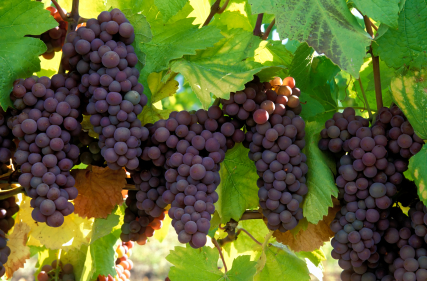
In today’s gospel reading, Jesus tells us that we should consider the fruit. Good fruit and bad fruit doesn’t happen by accident. I always wonder what the discerning will say about our congregation. When they consider the fruit of 110 years, what will they say? I see vibrant worship, a loving community, and strong partnerships in mission. I see transformed lives. Certainly, we are not a wolf in sheep’s clothing, but how do we stay healthy and strong? We must strive to do God’s will. We must not seek the easy way. We follow the path of Jesus Christ embodying his message of justice, hope, and life for the next 110 years.
Merciful God, bless today all the congregations of the Philadelphia Presbytery with good fruit. Amen.
“Prayer is not a normal part of the life of the natural man. We hear it said that a person’s life will suffer if he doesn’t pray, but I question that. What will suffer is the life of the Son of God in him, which is nourished not by food, but by prayer. When a person is born again from above, the life of the Son of God is born in him, and he can either starve or nourish that life. Prayer is the way that the life of God in us is nourished.”
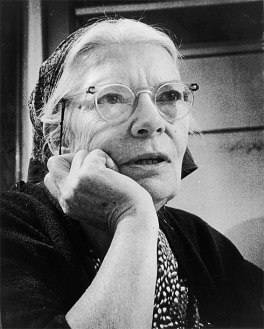
The events of the last few weeks have turned my attention to Dorothy Day. Her autobiography, The Long Loneliness, remains one of the most important books on the Christian faith that I have read in the last decade. As a Presbyterian pastor, I am a little surprised that I would be moved by one of the founders of the Catholic Worker Movement. Nonetheless, I am forever grateful to Jim Moore for introducing me to this woman of faith.
In 1906 when she was only 8 years old, Dorothy Day experienced the San Francisco earthquake while living across the bay in Oakland. There, in the midst of the destruction, she experienced compassion. People were giving clothes, making food, and sharing their possessions. Dorothy Day wrote, “It was as though they were united in Christian solidarity. It makes one think of how people could, if they would, care for each other in times of stress, unjudgingly in pity and love.” This experience was formative for her. It gave her a glimpse of God’s Kingdom.
Watching the aftermath of Hurricane Harvey reminded me of Dorothy Day’s glimpse. From the media coverage, I saw the man from Texas City launching his fishing boat into the flood waters declaring to the reporter, “I am going to try to save some lives.” I saw the volunteer who is leading a crew in Houston who stated, “It’s just the way I was raised up. Everybody else comes before me.” Again and again, people are doing the hard work of helping strangers, sacrificing for the sake of others.
Notice the contrast between what we saw in Charlottesville where pointy-headed idiots spouted hate and vitriol and clashed violently in the streets. I’m sure that not all the hurricane volunteers agree on every issue. I bet they are as divided as the rest of America is. However, when faced with great need, the divisions and differences melted away. They found common cause in love for neighbor.
Who is my neighbor? Jesus suggested that for the man hurting and beaten on the side of the road, his neighbor was one who acted in compassion. It didn’t matter his background, his ethnicity or even his theology. Jesus’ message for us is clear, “Go and do likewise.”
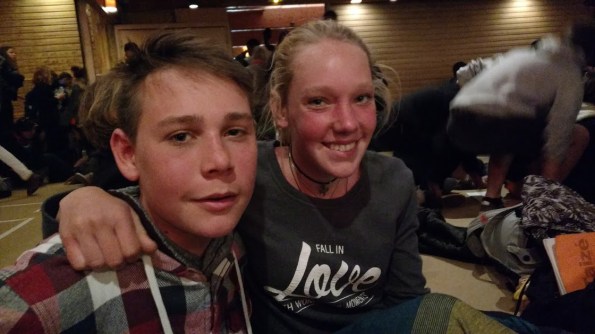
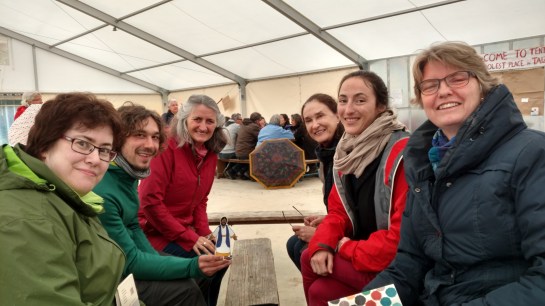
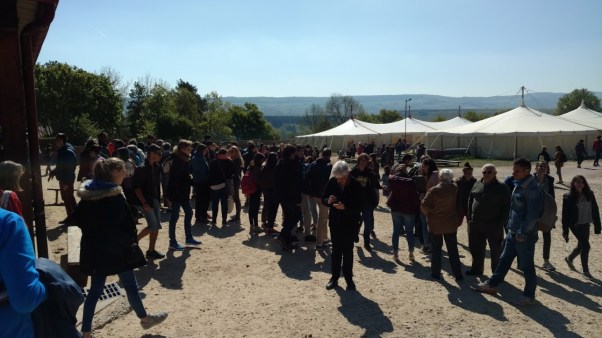
I arrived at Taize for Sunday morning worship on April 23. Two of the first people I met were Toby and Annika. For me, they epitomize the best of the Taize experience. The two are young, 16 and 18 respectively. Both have a sincere faith. Both are altar services in their Roman Catholic church in Cologne, Germany. Both are very kind. They gave some old, Protestant pastor from America pointers and advice as he entered his first Taize experience. Toby even gave me a ticket for a free crepe at the Oyak (like a camp store).
There was much confusing about that initial plunge into the Taize experience. However, Toby and Annika demonstrated to me from the beginning that there was something special happening there.
What is the Taize?
Taize is a small farming village in France. It was the place where Brother Roger established an ecumenical monastic community after World War II. Usually, we think of monastic communities as strictly Roman Catholic. However, there is a mix among the brothers of both Roman Catholic and Protestant. The brothers make lifelong vows of chastity, poverty, and obedience.
The curious thing about Taize is that the community was discovered by young people. By the early 1960s, young people were making pilgrimages to the community to join the brothers for a season of prayer and conversation. Thousands of people, church groups and individuals, will find themselves living in tents and cabins this year at Taize. They will eat together, pray together, and listen together.
Worship Experience
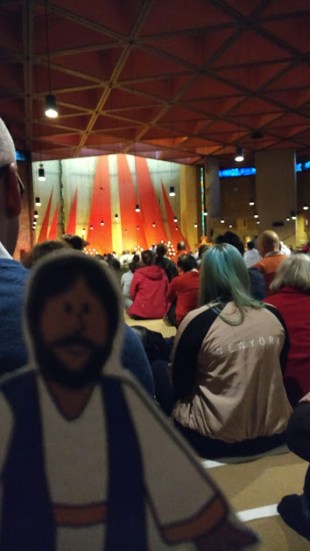
At the heart of the Taize community is the experience of worship. Three times a day, the community gathers in the Church of Reconciliation for prayer. The services are simple and multi-lingual. There is Scripture, prayer, and song.
Most people who know about Taize know about the songs. They are short, repetitive refrains. Perhaps, it could be a few sentences of Scripture breathed in and out. People find the songs centering and calming. At our congregation, we have used some of these songs for vespers services during times of the year or now even on Sunday morning.
I love the fact that the services are multi-lingual. There is something wonderful about so many people from so many places gathering to worship God in Jesus Christ. However, personally, I find singing new songs in Dutch, Spanish, Latin, French and German a little challenging. After a few worship services, I found myself simply repeating the lyrics in English and reflecting on them rather than singing every song.
The best attitude to take in a Taize service is not to participate in every part. Let the Holy Spirit move you. Sometimes you will be active. Sometimes you will be passive, allowing the elements of the service to affect you.
As a good Reformed Christian, I find the lack of Scripture teaching and preaching a little dismaying. However, I would argue that the daily Bible studies led by the brothers and small group reflections serve that purpose. One should view the whole day as worship rather than just the time in the Church of Reconciliation.
The Role of Community
Very soon after people arrive at Taize, there is an effort to gather them into small groups for Bible study and reflection. These same groups will often share jobs during the week as well. These could include helping with the distribution of food, washing dishes or even cleaning bathrooms.
In my group, we had people from Belgium, Switzerland, the Netherlands, France, Czech Republic, and Australia. We had devout believers, interested fellow travelers, and sincere questioners. In my short time there, we wrestled with the meaning of forgiveness, the nature of Jesus Christ, and applying the faith to our own lives.
Taize is about relationships–our relationship to God and each other. To get the most out of the experience, one needs to form connections fairly quickly. That’s probably why many travel to Taize in groups. They already have the benefit of existing relationships. Otherwise, a participant needs to be gregarious. Taize would be tough for an introvert.
The Language Barrier
The language barrier is real. Everyone that I have met has been very accommodating and kind. It is amazing how much can be communicated when folks share a common faith in Jesus Christ. People are very patient and loving. There is certainly a lot of laughter. Nonetheless, it’s frustrating when you can’t understand or cannot be understood. Pentecost was probably the best possible miracle for the early church. Christ came to tear down the walls that divide us from each other and from God. Language is certainly one of those walls.
Not Good for a Bad Back
Taize is not a place to go with a bad back. Before Easter, I injured my back, and after a difficult Holy Week, I almost had forgotten the pain I had experienced. However, Taize constantly reminded me. Most worship seated on the floor. There are very few places to sit other than hard wooden benches or concrete. The beds are incredibly uncomfortable.
This led to some interesting observations. During worship, I sought out one of the few benches along the periphery of the church. The view isn’t that great, but I prefer less pain. These benches were also the home of those youth who particularly didn’t want to be there. They were forced to come along with their church youth group. Sitting near me was the eye-rolling boy from Germany, the class clown from France, and the flirtatious young lady from Switzerland. These were not the most devout, but even they had an openness to God’s movement.
In a conversation with one of the brothers, we both observed that in today’s generation there is receptivity to the faith. They may not have the vocabulary to express their longings or their experiences of the divine. Nonetheless, there is something there. A generation or two ago, young people were rebelling against the church. Now the church is real counter-culture.
What are You Taking Home?
In my conversations with others at Taize, there was a question that I kept asking, “What are you going to take home from this experience?” At one point, someone threw the same question back at me. It was harder than I thought it would be. I think what I will take back is the questions.
The participants are from all over the world, yet there is clearly some spiritual challenges that reveal themselves over and over again: What brings my life meaning? How do I escape the trap of the expectations of the culture, my family, etc? How do I stay connected to a greater reality in this crazy world? What role does family, career or sexuality play in my identity? What is our responsibility to the poor? How do we make a difference? Where is God in all this?
Those common questions and the answers that we discover in our Christian faith provide a challenging agenda for the church.
I have been posting regularly until I lost almost all internet access in Taize. Nonetheless, I thought some might appreciate more of a narrative account rather than a topical one.
EASTER SUNDAY, April 16
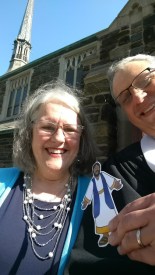
Christ is risen! He is risen indeed!
The worship service was glorious. Many don’t realize the work that goes on behind the scenes in preparation for the celebration. There are many volunteers and staff who worked so hard to make everything perfect. The music was great. The youth did a great job for the early service. The breakfast was wonderful.
The text for the morning focused on the words of the angel and Jesus to the two Marys at the empty tomb, “Do not be afraid” (Matthew 28:5,10).
April 17, 2017
Monday was spent getting all the last minute arrangements and an MRI. I’m not sure what I did, but since Tuesday, my back was getting progressively worse. According to the MRI, my lower back is a bit of a mess. Nothing that requires surgery or a major intervention. A friend from college sent me a picture of his blood pressure score. Sometimes it is hard to believe that we are all getting older.
April 18, 2017
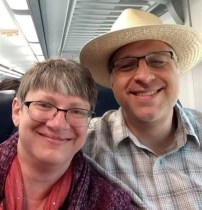
Tuesday we left for the airport. A friend from the animal shelter where Sara volunteers took us to Hamilton, NJ where we grabbed the train to the Newark airport. Then we were off to Dublin via Wow Airlines. It’s a budget airline out of Iceland. We stopped in Reykjavik for a brief time.
April 19, 2017
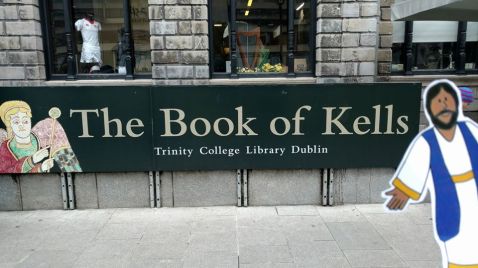
Wednesday we arrived in Dublin. We stayed at the Times Hostel near Trinity College. The conditions were spartan but comfortable. It was cheap and close to everything that we wanted to see.
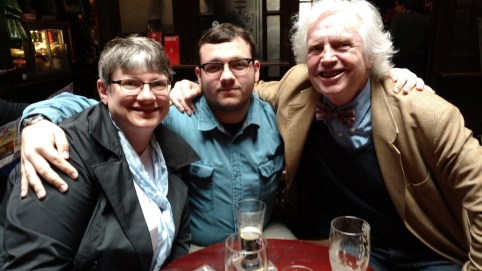
That afternoon we visited the Book of Kells, and we walked the much of the downtown area. We visited the post office where the Easter Rebellion occurred in 1916 which paved the way an independent Ireland. We took in a Guiness at a local pub, and that evening, we took a bus tour of the city.
April 20, 2017
Bright and early on Thursday we were prepared to go on a U2 tour. Unfortunately, our tour guide didn’t arrive. We were very disappointed, and later I received a call from the tour company. They made a huge mistake, and they wanted to schedule for the afternoon.
That afternoon, we met PJ Murphy-O’Brien. He showed us Bono’s and James Joyce’s Dublin. It wasn’t exactly what we were expected, but we had a great time. After the tour, Sara and I attended a public reading of James Joyce which was being recorded by a local Dublin television station. Sara and I might even be part of a future broadcast.
April 21, 2017
Friday, the family split. Sara and Thomas flew to London, and I went to France. I was eventually headed to the Taize Community to be a bit like a monk for a few days. Sara and Thomas always the saner members of the family declined.
After arriving in Lyon, I rented a car. Driving in a foreign country can be a challenge especially if you don’t know any of the local language. The hardest part was trying to change the GPS language from Polish to English. Also, it was fun driving a manuel transmission again. The last time I drove stick shift was back in high school on a little pick-up truck in East Texas.
April 22, 2017
My first stop before going to Taize was stopping at Cluny. I stayed with Airbnb. My hosts were incredible. Accommodations were wonderful. Breakfast was great, and Savan, the family dog, was very welcoming. If you are ever in the Burgundy region of France, I would highly recommend you visit.
That day, I visited what was left of the Abbey of Cluny. It’s an amazing bit of history that is all but forgotten. It was amazing to learn this bit of history of the Christian church in Europe. That evening, I tried escargot. It’s a local speciality. Butter and garlic make anything better.
In 2009, Rev. James Hodsden came to Ardmore Presbyterian Church to serve as our pastor. At the time, there were discussions with the Pastor Nominating Committee that after seven years Pastor James would receive a three-month sabbatical. A sabbatical for a pastor is not vacation or a time to produce a book or a thesis. Instead, it is a time for renewal and reformation. It’s a time to reconnect with God.
Gratefully, the church has received a grant from the Lilly Foundation to make this sabbatical possible. Pastor James has taken the theme of Reformation for this sabbatical. He will be traveling abroad to visit Reformation sites in Europe and to participate in an archaeological dig in Israel. What does reformation mean for us today? This all begins after Easter, April 16, 2017 What happens at Ardmore Presbyterian Church while Pastor James is gone?
The church’s life will certainly continue in the three months that Pastor James is gone. We will be celebrating Pentecost, the Wind-Up of the program year, and Vacation Bible School. We have a capable staff who will be making sure that nothing is left undone.
We also will be getting some help from some outside sources. Rev. Mike Pulsifer served at APC as the interim pastor before Pastor James’ arrival in 2009. He will be coming to help the church in all the administrative tasks that need to be done. He will be serving as our elder statesman, keeping a steady hand on the helm. Who will be doing pastoral care when Pastor James is on sabbatical?
The church has a capable lay visitation ministry, and the deacons will provide caring ministries for APC. Beyond that, we are asking for some help from a familiar face. Rev. Sturgis Poorman has served APC as a parish associate for years. Not only has he been the manager of the church’s softball team. He has also been involved in visitation and mission. Pastor Sturge will be handling all the pastoral care needs as they arise in Pastor James’ absence. Who will be preaching while Pastor James is away?
Rev. Poorman and Rev. Pulsifer will be helping lead worship during the sabbatical, but they aren’t the only ones. Leaders and members of the congregation will also be preaching from the pulpit. Considering our theme of Reformation, we will be employing the “priesthood of all believers.” We will be hearing the witness of Scripture through our friends and neighbors. Rev. Graham Robinson who has taught preaching in seminaries will be coaching our members. He will help them bring their best to God.
This devotional was written for the 300th anniversary of the Philadelphia Presbytery. The gospel reading for March 17, 2017, is John 5:30-47.
There is an old story about the theologian who is asked for a proof of God’s existence. The theologian says, “I don’t have a proof, but I do know a lady in Connecticut.” In other words, there may not be a mathematic proof with absolute certainty, but there are witnesses, people who are in relationship to God.
In today’s gospel reading, Jesus does not give a proof of who he is. In fact, he says, “If I testify about myself, my testimony is not true” (John 5:31). Instead, Jesus suggests that he can only be known in relationship—to the witnesses of John the Baptist, of the Hebrew Scriptures, and most importantly of God. We cannot isolate Jesus like an element in a laboratory experiment. Instead, we must consider the patterns of relationship.
The life of faith is never done alone. It’s never just me and Jesus. Instead, we encounter Jesus in relationship to the Scriptures, the Sacraments, the Church and the world. Today we celebrate the evangelist and pastor, Patrick of Ireland. We should read his famous prayer as embracing those relationships, not escaping.
“…Christ with me,
Christ before me,
Christ behind me,
Christ in me…”
On Christmas Day 2008, our family packed the last of our things and left Texas to come to Philadelphia. I became the pastor of the Ardmore Presbyterian Church on the heels of this congregation’s centennial. I was and am excited to become a part of APC’s next century. I knew that my time here would be challenging, but I also knew that this congregation was willing to be supportive of their pastor. When I came, the church offered me a three-month sabbatical after serving seven years. They knew that after a season, it is necessary for a pastor to reflect, to rest and to retool for the next series of challenges. I am grateful for that foresight.
Last year, APC applied for a grant from the Lilly Foundation to provide resources to make my upcoming sabbatical fruitful for both me and the church. The Lilly Foundation saw what we are doing here, and they wanted to affirm our ministry together. We received a full grant, and I will be taking my sabbatical in 2017. I will be out of the pulpit following Easter until Sunday, July 23. During that time, our family will be traveling Europe during the 500th anniversary of the Reformation. Also, I will have an opportunity to participate in an archaeological dig in Israel.
When I am gone, the church will function normally. I am currently working with the session and other pastors to ensure that worship, pastoral and administrative duties will all be covered. We have great volunteers and a great staff. I have every confidence that the church will be fine in my absence.
There are many more details to come. My prayer is that 2017 will be a transformative year for all of us.
Grace & Peace,
Every four years, presidential candidates from the political parties prance and preen before the voters in primary politics. Invariably, these efforts seem to collide with the church’s calendar. Many followers of Jesus are now observing the season of Lent. At the same time, Christians are examining themselves, seeking repentance and humility, the airwaves are filled with men and women claiming to be the best hope for America.
If you have been paying attention, you probably noticed that every candidate is unhappy with the status quo. In that way, they seem to match the mood of the electorate. It doesn’t matter if you are a Republican or a Democrat. There is a sense of anxiety and unease about the state of our union. I have had several conversations with people, and I am hearing that we are afraid. We are afraid that terrorists will attack again. We are afraid that the economy will continue to falter. We are afraid that the nation has failed the next generation. The details change from person to person, party to party, but there is a sense that we have lost our way.
We are looking for a hero, and the politicians are eager to play the part. We want to take back our country, to start a revolution or to make America great again. Vote for this candidate or another, and all your dreams will come true. Unfortunately, we soon learn that no one can match the rhetoric and the high expectations.
I would never dissuade someone from participating in the political process, and I do believe that elections have consequences. People of faith should be politically active. Nonetheless, as Christians, we have a Messiah. Let’s stop looking for another.
When Jesus faced the kingdoms of this world, they sought to destroy him. They nailed him to a cross. Jesus stood for justice and righteousness, and the religious leaders and the Roman authorities killed him. However, that was the limit of their power. They couldn’t do worse.
By rising from the dead, Jesus demonstrated that the authorities of this world are impotent. God’s kingdom is triumphant. Politics can only accomplish so much. Our challenges may be real, but we don’t need to be afraid. The resurrection gives us the confidence to overcome our problems without demagoguery or demonization. We are less concerned with winning than seeking the truth or serving our neighbor. Easter rescues us from false messiahs.
In this day and age, our families are strewn around the world. Getting everyone physically together in one place is challenging. As a result, when it happens, it’s a big deal. There will be tears, laughter, hugs, and kisses. And the family will share stories.
Some of those stories will be new. The young couple announces that they are going to have a baby. Some of the stories will be old. Great-Grandfather facing hardship immigrated to this country. Some of the stories might be funny. There was that time when dad sang to mom in front of the whole restaurant. Some of the stories might be sad. Our aunt was incredibly brave as she faced Alzheimer’s.
Stories are important. They embody meaning and purpose for us. They help us find our place in the world. If you want to know what is important to a person, listen to the stories that he or she tell.
As part of God’s family, we also have stories. In fact, one could argue that the Christian faith itself is simply a story. God created a world that was good. God intended for us to live in relationship with him and with each other. Sadly something went wrong. Nonetheless, God did not allow our rebellion to change his love for us. Instead, God pursued us. When the time was right, he sent his Son, Jesus Christ, into the world to redeem us. Our lives are now dedicated to God living out the love and joy that he intended.
As Christians, we declare that the Bible is our only rule of faith and life. It describes our obligations to God. It teaches us morality and ethics. However, the Bible does more. We are invited into God’s story. When civil rights leaders echoed Moses declaring, “Let my people go,” they were accepting that invitation. When a missionary responds personally to Jesus’ words, “Go and preach to all creation,” she is accepting the invitation. When we respond to the prophets by “seeking the peace of the city,” we are accepting the invitation.
This year, I want to invite you into a deeper relationship with the Bible. There will be a number of opportunities to explore God’s story. The choir will be sharing it through Handel’s Messiah. Our Spiritual Enrichment Retreat will take us into the Scriptures from Genesis to Revelation. Through a variety of small groups, we will be exploring how we can make God’s story our own.
It all starts with Homecoming on September 13, 2015. As we gather the family, let us share our stories together.
 On this date 110 years ago, the Ardmore Presbyterian Church was formed. Things have changed a lot since 1907 even more so since the founding of the Philadelphia Presbytery in 1717. There have been triumphs and tears, good times and bad. Through it all, we have tried to maintain a faithful witness in our neighborhood and in the world.
 “Prayer is not a normal part of the life of the natural man. We hear it said that a person’s life will suffer if he doesn’t pray, but I question that. What will suffer is the life of the Son of God in him, which is nourished not by food, but by prayer. When a person is born again from above, the life of the Son of God is born in him, and he can either starve or nourish that life. Prayer is the way that the life of God in us is nourished.”
 The events of the last few weeks have turned my attention to Dorothy Day. Her autobiography,
 Taize is not a place to go with a bad back. Before Easter, I injured my back, and after a difficult Holy Week, I almost had forgotten the pain I had experienced. However, Taize constantly reminded me. Most worship seated on the floor. There are very few places to sit other than hard wooden benches or concrete. The beds are incredibly uncomfortable.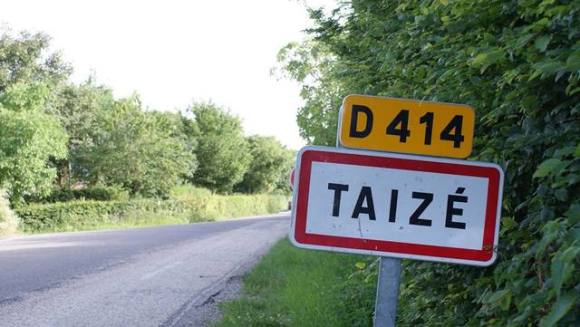
 Christ is risen! He is risen indeed!
 pril 18, 2017
 Wednesday we arrived in Dublin. We stayed at the Times Hostel near Trinity College. The conditions were spartan but comfortable. It was cheap and close to everything that we wanted to see.
 Bright and early on Thursday we were prepared to go on a U2 tour. Unfortunately, our tour guide didn’t arrive. We were very disappointed, and later I received a call from the tour company. They made a huge mistake, and they wanted to schedule for the afternoon.
 Friday, the family split. Sara and Thomas flew to London, and I went to France. I was eventually headed to the Taize Community to be a bit like a monk for a few days. Sara and Thomas always the saner members of the family declined.
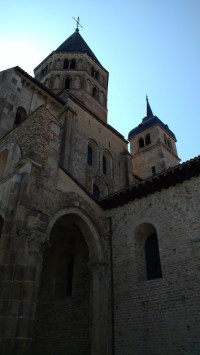 My first stop before going to Taize was stopping at Cluny. I stayed with Airbnb. My hosts were incredible. Accommodations were wonderful. Breakfast was great, and Savan, the family dog, was very welcoming. If you are ever in the Burgundy region of France, I would highly
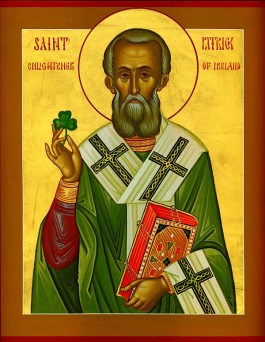 There is an old story about the theologian who is asked for a proof of God’s existence. The theologian says, “I don’t have a proof, but I do know a lady in Connecticut.” In other words, there may not be a mathematic proof with absolute certainty, but there are witnesses, people who are in relationship to God.
 On Christmas Day 2008, our family packed the last of our things and left Texas to come to Philadelphia. I became the pastor of the Ardmore Presbyterian Church on the heels of this congregation’s centennial. I was and am excited to become a part of APC’s next century. I knew that my time here would be challenging, but I also knew that this congregation was willing to be supportive of their pastor. When I came, the church offered me a three-month sabbatical after serving seven years. They knew that after a season, it is necessary for a pastor to reflect, to rest and to retool for the next series of challenges. I am grateful for that foresight.
 Every four years, presidential candidates from the political parties prance and preen before the voters in primary politics. Invariably, these efforts seem to collide with the church’s calendar. Many followers of Jesus are now observing the season of Lent. At the same time, Christians are examining themselves, seeking repentance and humility, the airwaves are filled with men and women claiming to be the best hope for America.
 In this day and age, our families are strewn around the world. Getting everyone physically together in one place is challenging. As a result, when it happens, it’s a big deal. There will be tears, laughter, hugs, and kisses. And the family will share stories.
 Pastor 139