This devotional was written for the 300th anniversary of the Philadelphia Presbytery. The gospel reading for October 4, 2017, is Matthew 7:13-21.
On this date 110 years ago, the Ardmore Presbyterian Church was formed. Things have changed a lot since 1907 even more so since the founding of the Philadelphia Presbytery in 1717. There have been triumphs and tears, good times and bad. Through it all, we have tried to maintain a faithful witness in our neighborhood and in the world.
In today’s gospel reading, Jesus tells us that we should consider the fruit. Good fruit and bad fruit doesn’t happen by accident. I always wonder what the discerning will say about our congregation. When they consider the fruit of 110 years, what will they say? I see vibrant worship, a loving community, and strong partnerships in mission. I see transformed lives. Certainly, we are not a wolf in sheep’s clothing, but how do we stay healthy and strong? We must strive to do God’s will. We must not seek the easy way. We follow the path of Jesus Christ embodying his message of justice, hope, and life for the next 110 years.
Merciful God, bless today all the congregations of the Philadelphia Presbytery with good fruit. Amen.
“Prayer is not a normal part of the life of the natural man. We hear it said that a person’s life will suffer if he doesn’t pray, but I question that. What will suffer is the life of the Son of God in him, which is nourished not by food, but by prayer. When a person is born again from above, the life of the Son of God is born in him, and he can either starve or nourish that life. Prayer is the way that the life of God in us is nourished.”
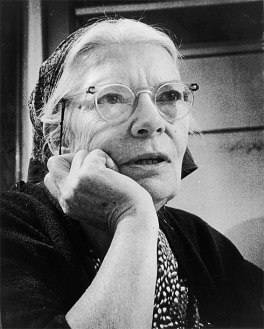
The events of the last few weeks have turned my attention to Dorothy Day. Her autobiography, The Long Loneliness, remains one of the most important books on the Christian faith that I have read in the last decade. As a Presbyterian pastor, I am a little surprised that I would be moved by one of the founders of the Catholic Worker Movement. Nonetheless, I am forever grateful to Jim Moore for introducing me to this woman of faith.
In 1906 when she was only 8 years old, Dorothy Day experienced the San Francisco earthquake while living across the bay in Oakland. There, in the midst of the destruction, she experienced compassion. People were giving clothes, making food, and sharing their possessions. Dorothy Day wrote, “It was as though they were united in Christian solidarity. It makes one think of how people could, if they would, care for each other in times of stress, unjudgingly in pity and love.” This experience was formative for her. It gave her a glimpse of God’s Kingdom.
Watching the aftermath of Hurricane Harvey reminded me of Dorothy Day’s glimpse. From the media coverage, I saw the man from Texas City launching his fishing boat into the flood waters declaring to the reporter, “I am going to try to save some lives.” I saw the volunteer who is leading a crew in Houston who stated, “It’s just the way I was raised up. Everybody else comes before me.” Again and again, people are doing the hard work of helping strangers, sacrificing for the sake of others.
Notice the contrast between what we saw in Charlottesville where pointy-headed idiots spouted hate and vitriol and clashed violently in the streets. I’m sure that not all the hurricane volunteers agree on every issue. I bet they are as divided as the rest of America is. However, when faced with great need, the divisions and differences melted away. They found common cause in love for neighbor.
Who is my neighbor? Jesus suggested that for the man hurting and beaten on the side of the road, his neighbor was one who acted in compassion. It didn’t matter his background, his ethnicity or even his theology. Jesus’ message for us is clear, “Go and do likewise.”
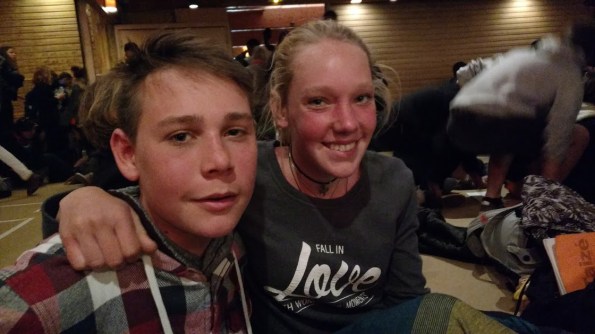
I arrived at Taize for Sunday morning worship on April 23. Two of the first people I met were Toby and Annika. For me, they epitomize the best of the Taize experience. The two are young, 16 and 18 respectively. Both have a sincere faith. Both are altar services in their Roman Catholic church in Cologne, Germany. Both are very kind. They gave some old, Protestant pastor from America pointers and advice as he entered his first Taize experience. Toby even gave me a ticket for a free crepe at the Oyak (like a camp store).
There was much confusing about that initial plunge into the Taize experience. However, Toby and Annika demonstrated to me from the beginning that there was something special happening there.
What is the Taize?
Taize is a small farming village in France. It was the place where Brother Roger established an ecumenical monastic community after World War II. Usually, we think of monastic communities as strictly Roman Catholic. However, there is a mix among the brothers of both Roman Catholic and Protestant. The brothers make lifelong vows of chastity, poverty, and obedience.
The curious thing about Taize is that the community was discovered by young people. By the early 1960s, young people were making pilgrimages to the community to join the brothers for a season of prayer and conversation. Thousands of people, church groups and individuals, will find themselves living in tents and cabins this year at Taize. They will eat together, pray together, and listen together.
Worship Experience
At the heart of the Taize community is the experience of worship. Three times a day, the community gathers in the Church of Reconciliation for prayer. The services are simple and multi-lingual. There is Scripture, prayer, and song.
Most people who know about Taize know about the songs. They are short, repetitive refrains. Perhaps, it could be a few sentences of Scripture breathed in and out. People find the songs centering and calming. At our congregation, we have used some of these songs for vespers services during times of the year or now even on Sunday morning.
I love the fact that the services are multi-lingual. There is something wonderful about so many people from so many places gathering to worship God in Jesus Christ. However, personally, I find singing new songs in Dutch, Spanish, Latin, French and German a little challenging. After a few worship services, I found myself simply repeating the lyrics in English and reflecting on them rather than singing every song.
The best attitude to take in a Taize service is not to participate in every part. Let the Holy Spirit move you. Sometimes you will be active. Sometimes you will be passive, allowing the elements of the service to affect you.
As a good Reformed Christian, I find the lack of Scripture teaching and preaching a little dismaying. However, I would argue that the daily Bible studies led by the brothers and small group reflections serve that purpose. One should view the whole day as worship rather than just the time in the Church of Reconciliation.
The Role of Community
Very soon after people arrive at Taize, there is an effort to gather them into small groups for Bible study and reflection. These same groups will often share jobs during the week as well. These could include helping with the distribution of food, washing dishes or even cleaning bathrooms.
In my group, we had people from Belgium, Switzerland, the Netherlands, France, Czech Republic, and Australia. We had devout believers, interested fellow travelers, and sincere questioners. In my short time there, we wrestled with the meaning of forgiveness, the nature of Jesus Christ, and applying the faith to our own lives.
Taize is about relationships–our relationship to God and each other. To get the most out of the experience, one needs to form connections fairly quickly. That’s probably why many travel to Taize in groups. They already have the benefit of existing relationships. Otherwise, a participant needs to be gregarious. Taize would be tough for an introvert.
The Language Barrier
The language barrier is real. Everyone that I have met has been very accommodating and kind. It is amazing how much can be communicated when folks share a common faith in Jesus Christ. People are very patient and loving. There is certainly a lot of laughter. Nonetheless, it’s frustrating when you can’t understand or cannot be understood. Pentecost was probably the best possible miracle for the early church. Christ came to tear down the walls that divide us from each other and from God. Language is certainly one of those walls.
Not Good for a Bad Back
Taize is not a place to go with a bad back. Before Easter, I injured my back, and after a difficult Holy Week, I almost had forgotten the pain I had experienced. However, Taize constantly reminded me. Most worship seated on the floor. There are very few places to sit other than hard wooden benches or concrete. The beds are incredibly uncomfortable.
This led to some interesting observations. During worship, I sought out one of the few benches along the periphery of the church. The view isn’t that great, but I prefer less pain. These benches were also the home of those youth who particularly didn’t want to be there. They were forced to come along with their church youth group. Sitting near me was the eye-rolling boy from Germany, the class clown from France, and the flirtatious young lady from Switzerland. These were not the most devout, but even they had an openness to God’s movement.
In a conversation with one of the brothers, we both observed that in today’s generation there is receptivity to the faith. They may not have the vocabulary to express their longings or their experiences of the divine. Nonetheless, there is something there. A generation or two ago, young people were rebelling against the church. Now the church is real counter-culture.
What are You Taking Home?
In my conversations with others at Taize, there was a question that I kept asking, “What are you going to take home from this experience?” At one point, someone threw the same question back at me. It was harder than I thought it would be. I think what I will take back is the questions.
The participants are from all over the world, yet there is clearly some spiritual challenges that reveal themselves over and over again: What brings my life meaning? How do I escape the trap of the expectations of the culture, my family, etc? How do I stay connected to a greater reality in this crazy world? What role does family, career or sexuality play in my identity? What is our responsibility to the poor? How do we make a difference? Where is God in all this?
Those common questions and the answers that we discover in our Christian faith provide a challenging agenda for the church.
Roger Schütz was born in Switzerland in the days before World War I. He grew up hearing stories about his French grandmother caring for refugees from that war. The war had a profound impact on her. She was horrified that Christians would be slaughtering each other in that conflict. She taught her grandson that reconciliation, especially among Christians, was necessary to avoid another war.
Roger, the son of a Protestant minister, went on to study theology at the universities of Strasbourg and Lausanne. He wrote his dissertation on early monasticism which led him to believe that Protestantism needed an option for an intentional community of prayer and worship.
When war came again to Europe, Roger combined his desire for a monastic life and his compassion to help the victims of the war. In 1940, he left Switzerland and found his way to the village Taize which was near the border between Vichy and free France.
Roger bought a home in Taize and invited his sister to come and help him minister to the refugees in the area, including escaping Jews. Slowly there emerged a pattern of prayer and a way of life at Taize until 1942 when the two were warned to flee the Gestapo who were searching for refugees.
At the end of the war, Roger returned with another who began an intentional community at Taize. This time they were caring for victims of the war including abandoned children and also German prisioners of war.
As the community grew, Roger developed a rule of life for their Protestant monastery. Later Roman Catholics came, and the community became intentionally ecumenical. In 1959, young people started coming to the community. Many are searching for meaning and wrestling with the social changes that were occurring around them. Hundreds became thousands each year. The Taize community continues to welcome young people from all over the world.
Later, the community would organize events for youth all over the world called, “Pilgrimages of Trust.” These events emphasize reconciliation, simplicity prayer, and trust. These “pilgrimages” were the inspiration for World Youth Day by the Roman Catholic Church.
At the heart of Taize is the worship. Three times a day, the brothers gather for Scripture, prayer, and song. The liturgy is simple and multi-lingual. It combines many religious traditions including icons, stained glass, and post-modern art. Many find the times of worship quite meaningful. However, it is really the small group time of bible study, reflection, and common life which provide the foundation for the time of worship.
In 2005, Brother Roger was attacked during worship by a woman suffering from mental illness. He died soon after being stabbed multiple times. The contrast of a life dedicated to non-violence and such a violent death is quite shocking. However, his death demonstrates that the work of the community is not done. They remain to show a community in contrast. The community strives to be a witness to the way of Christ.
I have been posting regularly until I lost almost all internet access in Taize. Nonetheless, I thought some might appreciate more of a narrative account rather than a topical one.
EASTER SUNDAY, April 16
Christ is risen! He is risen indeed!
The worship service was glorious. Many don’t realize the work that goes on behind the scenes in preparation for the celebration. There are many volunteers and staff who worked so hard to make everything perfect. The music was great. The youth did a great job for the early service. The breakfast was wonderful.
The text for the morning focused on the words of the angel and Jesus to the two Marys at the empty tomb, “Do not be afraid” (Matthew 28:5,10).
April 17, 2017
Monday was spent getting all the last minute arrangements and an MRI. I’m not sure what I did, but since Tuesday, my back was getting progressively worse. According to the MRI, my lower back is a bit of a mess. Nothing that requires surgery or a major intervention. A friend from college sent me a picture of his blood pressure score. Sometimes it is hard to believe that we are all getting older.
April 18, 2017
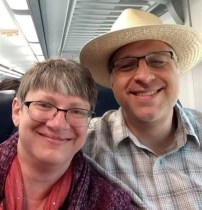
Tuesday we left for the airport. A friend from the animal shelter where Sara volunteers took us to Hamilton, NJ where we grabbed the train to the Newark airport. Then we were off to Dublin via Wow Airlines. It’s a budget airline out of Iceland. We stopped in Reykjavik for a brief time.
April 19, 2017
Wednesday we arrived in Dublin. We stayed at the Times Hostel near Trinity College. The conditions were spartan but comfortable. It was cheap and close to everything that we wanted to see.
That afternoon we visited the Book of Kells, and we walked the much of the downtown area. We visited the post office where the Easter Rebellion occurred in 1916 which paved the way an independent Ireland. We took in a Guiness at a local pub, and that evening, we took a bus tour of the city.
April 20, 2017
Bright and early on Thursday we were prepared to go on a U2 tour. Unfortunately, our tour guide didn’t arrive. We were very disappointed, and later I received a call from the tour company. They made a huge mistake, and they wanted to schedule for the afternoon.
That afternoon, we met PJ Murphy-O’Brien. He showed us Bono’s and James Joyce’s Dublin. It wasn’t exactly what we were expected, but we had a great time. After the tour, Sara and I attended a public reading of James Joyce which was being recorded by a local Dublin television station. Sara and I might even be part of a future broadcast.
April 21, 2017
Friday, the family split. Sara and Thomas flew to London, and I went to France. I was eventually headed to the Taize Community to be a bit like a monk for a few days. Sara and Thomas always the saner members of the family declined.
After arriving in Lyon, I rented a car. Driving in a foreign country can be a challenge especially if you don’t know any of the local language. The hardest part was trying to change the GPS language from Polish to English. Also, it was fun driving a manuel transmission again. The last time I drove stick shift was back in high school on a little pick-up truck in East Texas.
April 22, 2017
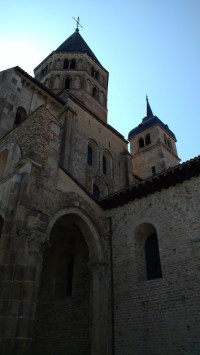
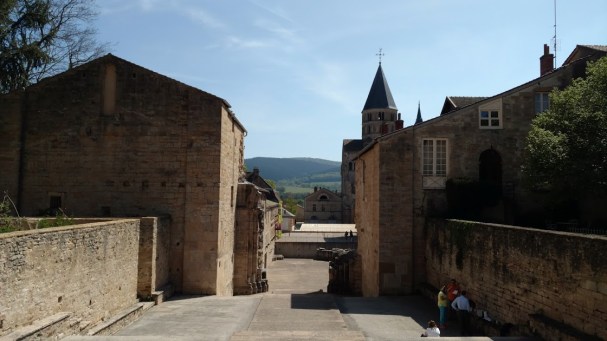
My first stop before going to Taize was stopping at Cluny. I stayed with Airbnb. My hosts were incredible. Accommodations were wonderful. Breakfast was great, and Savan, the family dog, was very welcoming. If you are ever in the Burgundy region of France, I would highly recommend you visit.
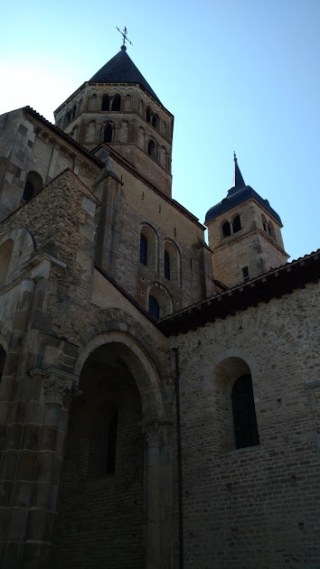
That day, I visited what was left of the Abbey of Cluny. It’s an amazing bit of history that is all but forgotten. It was amazing to learn this bit of history of the Christian church in Europe. That evening, I tried escargot. It’s a local speciality. Butter and garlic make anything better.
For the past couple of days, I’ve been visiting Cluny which is north of Lyon, France. It’s a beautiful rural, small village which once was one of the most important places in Europe.
I’ve already written about how the monastic movement kept the Christian movement going by recovering and perpetuating sacred texts. The movement also provided cultural stability during the turbulent times after the fall of the Roman Empire. They also provided needed support for the poor and sick in those communities.
That being said, not all monasteries were equal. The quality and faithfulness of those monasteries could vary wildly. Folks like St. Columba in Scotland and St. Benedict in Italy tried to create a systematic rule of life for their communities. For example, St. Benedict’s Rule has been a standard for monastic communities since it was written in the Sixth Century.
However, by the height of the Middle Ages, there was a new challenge. Monasteries needed land. As a result, the monasteries were becoming ever dependent on the arising feudal lords. Those lords were often exercising power over the monasteries including internal practices. Some lords taxed the monasteries into poverty. Others influenced them to modify St. Benedict’s Rule, lowering their standards. As a result, the monasteries went into decline.
The Virgin Mary with some of the esteemed abbots of Cluny. From Church of Notre Dame in Cluny.
In the early 10th Century, William the Pious, the duke of Aquitaine and count of Macon in France, made a deal with the church. He would give away his villa at Cluny to the church for a monastery. What was different about this deal was that Cluny would remain independent from his influence. The Rule of St. Benedict would be strictly enforced, and the lands were rich enough to make the monastery sustainable. William probably hoped that such a deal would secure his eternal soul.
The Abbey of Cluny had some smart abbots who leveraged their position well. Soon other monasteries began to ally themselves with the independent Cluny. They also began to start new monasteries. Eventually, the Abbey of Cluny created a network of monasteries in France, England, Spain and Italy. The pope even gave the abbey a special dispensation to bypass existing bishops to run the other monasteries directly.
Cluny began to rival Rome as the center of power of the Christian church. At its height of influence, 1184 other monasteries were allied with Cluny. From the 12th Century to the 16th Century, the largest church building in Europe was in Cluny, even larger than the Vatican. Over the years, the Abbey at Cluny produced popes and saints. The monasteries became knowns for their liturgy, music, reflection on Scripture, and helping the poor.
However, the Cluniac reform movement was a victim of its own success. The network grew too large. They couldn’t maintain centralized control on all those monasteries. Likewise, they became corrupted by their great wealth and power. Other reformers saw the Cluniac monasteries as losing touch with the Gospel. Eventually, the power of Cluny waned. After the French Revolution, the revolutionaries dissolved the monastery and tore down many of the buildings.
The history of Cluny reveals that spiritual reforms must be made concrete. The Gospel must be incarnational. However, Cluny also teaches that heart of any reform movement must remain the good news of Jesus Christ. The concrete must be guided by the spiritual.
My wife is a huge fan of the band U2. No, really, she is a huge fan. Some of you might remember the study she led, “U2 and the Bible” where she explored the music and lyrics of U2 from a spiritual perspective. Much of their music has been influenced by the members’ Christian faith. One of my personal favorites has been the song, “Grace.”
In 1982, the band has something of a spiritual crisis. Bono, the Edge, and Larry Mullen were attending Shalom Fellowship. It’s a charismatic church in Dublin which was born out of an alternative to the ongoing Protestant-Catholic tensions in Ireland. At one point, a member of the fellowship has a prophetic vision about the band. God wanted them to quit playing rock and roll. The pastor and others in the fellowship put great pressure on the three. Although I might have completely discounted this vision, to their credit these band members took it seriously. They decided that the only way they could move forward is if they could find a way to maintain their faith while remaining in the band. Thankfully, they found that path.
Here’s a fascinating video where Bono shares a bit about his faith.
On Thursday, we were scheduled to take a U2 tour of Dublin for Sara. Unfortunately, some confusion occurred, and the tour guide never came. Needless to say, there was a great deal of disappointment. Then the tour company called us apologizing saying that they got the time wrong. They wanted to make it right.
The company sent over P.J. Murphy-O’Brien who took us on a walking tour of Dublin with an emphasis on U2. P.J. is also a James Joyce scholar so we had plenty of Joyce with our U2. And, he threw in a pub crawl as well.
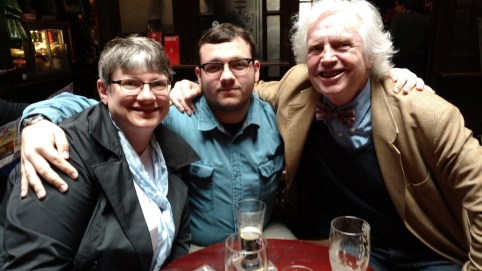
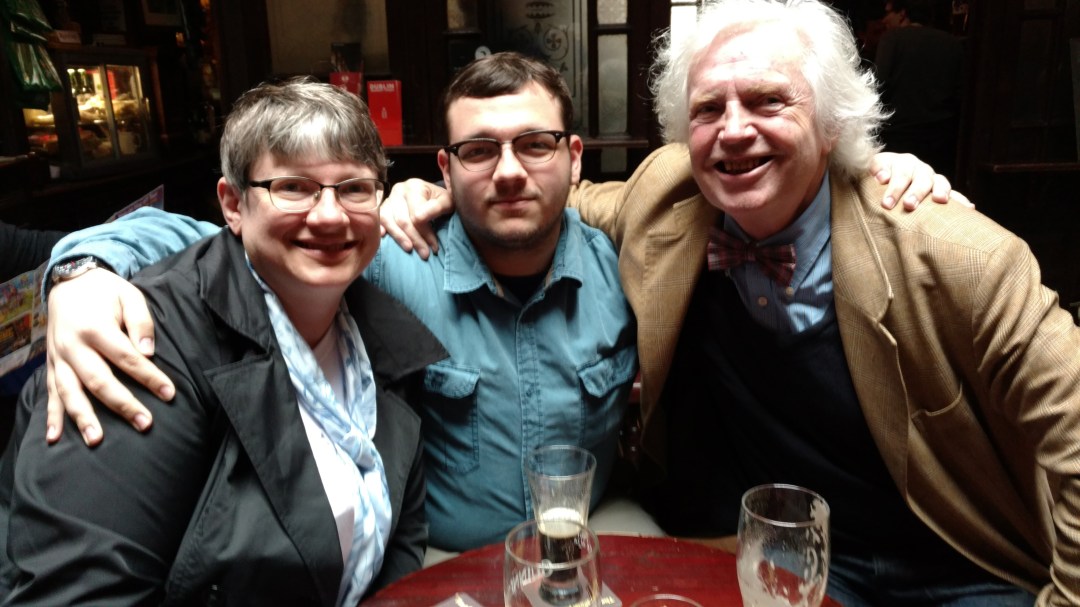
Sara, Thomas, and PJ Murphy-O’Brien
Many Christians are dismissive of James Joyce. He certainly can be very critical of the Catholic faith in which he was raised. After all, in chapter five of Ulysses, he compares the lotus-eaters in Homer to those who partake of the Holy Eucharist. Still, Christians should be gracious enough to hear the criticisms from our “cultured despisers.”
The tour was great, and it even ended with a public reading of James Joyce. If you are watching Dublin television, you might even catch Sara and me reading an excerpt.
“…a young healthy child well nursed is at a year old a most delicious, nourishing, and wholesome food, whether stewed, roasted, baked, or boiled; and I make no doubt that it will equally serve in a fricassee or a ragout.”
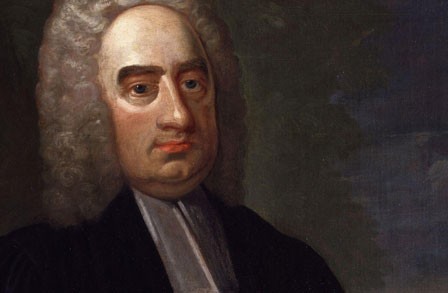
It is considered one of the great works of satire. In 1729, Jonathan Swift published A Modest Proposal to critique the inattention of the English rich and powerful to the poor of Ireland. This along with works like Gulliver’s Travels have secured Swift’s position in English literature.
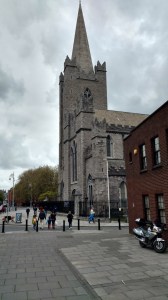
What is lesser known is that Swift, when he wrote both A Modest Proposal and Gulliver’s Travels, was dean of St. Patrick’s Cathedral in Dublin from 1713 to 1745. He was the head pastor and preacher.
Swift hated hypocrisy, and he hated putting on airs. That certainly is reflected in his writing. Swift could be acerbic and cynical. it also meant that he could be a bit reticent about his own piety. In fact, some contemporaries questioned whether Swift was even Christian. Nonetheless, his humility hid a deep abiding faith. There are reports about his great devotion to prayer and the eucharist. His personal generosity and care for the poor were well-known.
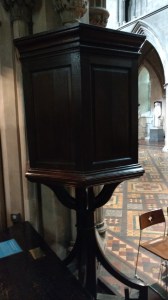
The pulpit that Jonathan Swift preached from.
Rather than being a misanthrope, Swift simply had a healthy understanding of the doctrine of Original Sin. All had fallen short of the glory of God. Most cynics that I know are disappointed reformers. At least Swift had a clear understanding of God’s mercy and goodness to balance his critique of human institutions. The Sermon on the Mount declares, “blessed are those that mourn” (Matthew 5:4). The curmudgeons of the world are blessed because they know that this is not the way things are supposed to be.
Swift lived out his Christian faith by revealing the foibles and follies of human beings. He poked fun at traditions and institutions with a mind for their reform. Behind his wit was hope.
Yesterday, we visited the Book of Kells at Trinity College in Dublin, and I have been thinking more about those monks who ensured that the Christian tradition was passed down from one generation to another. I remembered a poem that I once read by an anonymous Irish monk from the 9th Century about his pet cat named Pangur Ban.
I and Pangur Bán my cat,
‘Tis a like task we are at:
Hunting mice is his delight,
Hunting words I sit all night.
Better far than praise of men
‘Tis to sit with book and pen;
Pangur bears me no ill-will,
He too plies his simple skill.
‘Tis a merry task to see
At our tasks how glad are we,
When at home we sit and find
Entertainment to our mind.
Oftentimes a mouse will stray
In the hero Pangur’s way;
Oftentimes my keen thought set
Takes a meaning in its net.
‘Gainst the wall he sets his eye
Full and fierce and sharp and sly;
‘Gainst the wall of knowledge I
All my little wisdom try.
When a mouse darts from its den,
O how glad is Pangur then!
O what gladness do I prove
When I solve the doubts I love!
So in peace our task we ply, Pangur Bán, my cat, and I;
In our arts we find our bliss,
I have mine and he has his.
Practice every day has made Pangur perfect in his trade;
I get wisdom day and night
Turning darkness into light.
There is beauty in a job well-done even if it is a cat chasing a mouse or a theologian chasing an argument. As the Preacher notes,
“So I saw that there is nothing better for a person than to enjoy their work, because that is their lot. For who can bring them to see what will happen after them?” Ecclesiastes 3:22
If you can appreciate this poem and the joy of vocation, you might like a children’s book about Pangur Ban entitled, The White Cat and the Monkby writer Jo Ellen Bogart and illustrator Sydney Smith.
 On this date 110 years ago, the Ardmore Presbyterian Church was formed. Things have changed a lot since 1907 even more so since the founding of the Philadelphia Presbytery in 1717. There have been triumphs and tears, good times and bad. Through it all, we have tried to maintain a faithful witness in our neighborhood and in the world.
 “Prayer is not a normal part of the life of the natural man. We hear it said that a person’s life will suffer if he doesn’t pray, but I question that. What will suffer is the life of the Son of God in him, which is nourished not by food, but by prayer. When a person is born again from above, the life of the Son of God is born in him, and he can either starve or nourish that life. Prayer is the way that the life of God in us is nourished.”
 The events of the last few weeks have turned my attention to Dorothy Day. Her autobiography,
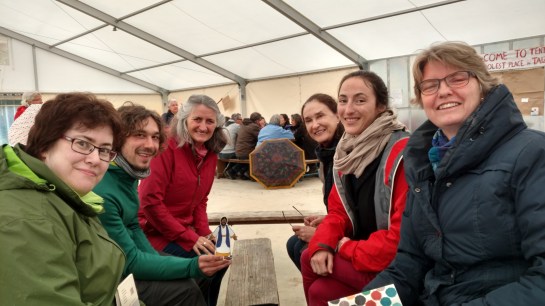
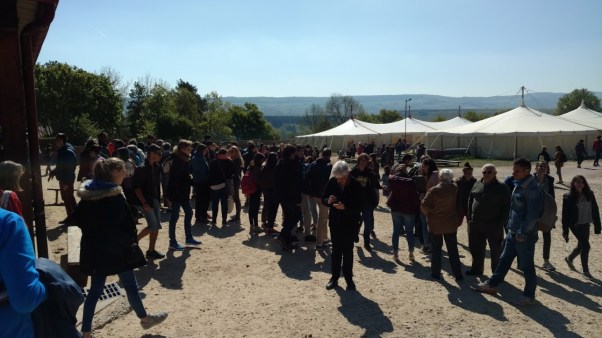
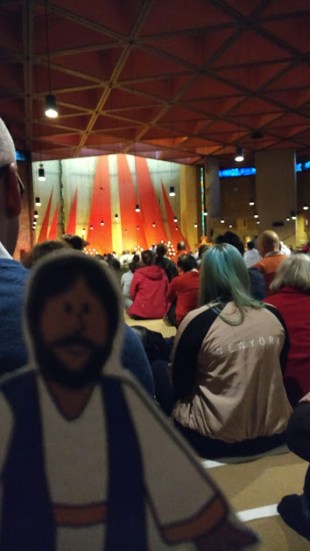 Taize is not a place to go with a bad back. Before Easter, I injured my back, and after a difficult Holy Week, I almost had forgotten the pain I had experienced. However, Taize constantly reminded me. Most worship seated on the floor. There are very few places to sit other than hard wooden benches or concrete. The beds are incredibly uncomfortable.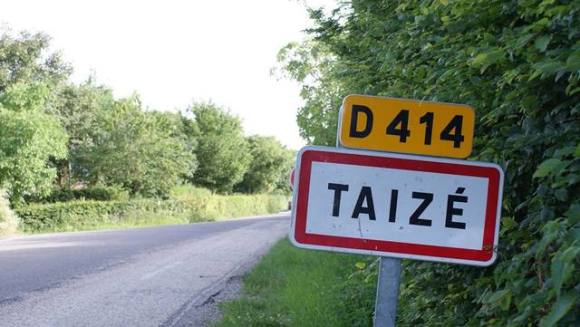
 Roger Schütz was born in Switzerland in the days before World War I. He grew up hearing stories about his French grandmother caring for refugees from that war. The war had a profound impact on her. She was horrified that Christians would be slaughtering each other in that conflict. She taught her grandson that reconciliation, especially among Christians, was necessary to avoid another war.
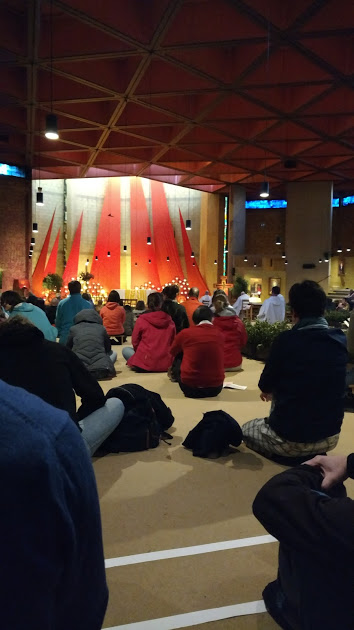 As the community grew, Roger developed a rule of life for their Protestant monastery. Later Roman Catholics came, and the community became intentionally ecumenical. In 1959, young people started coming to the community. Many are searching for meaning and wrestling with the social changes that were occurring around them. Hundreds became thousands each year. The Taize community continues to welcome young people from all over the world.
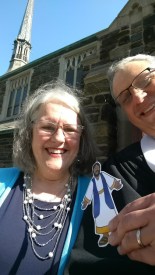 Christ is risen! He is risen indeed!
 pril 18, 2017
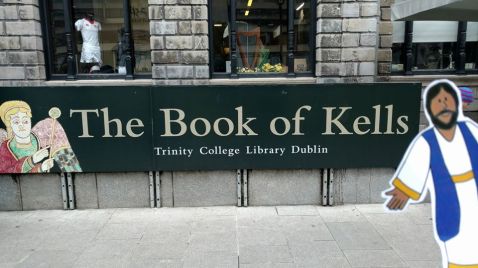 Wednesday we arrived in Dublin. We stayed at the Times Hostel near Trinity College. The conditions were spartan but comfortable. It was cheap and close to everything that we wanted to see.
 Bright and early on Thursday we were prepared to go on a U2 tour. Unfortunately, our tour guide didn’t arrive. We were very disappointed, and later I received a call from the tour company. They made a huge mistake, and they wanted to schedule for the afternoon.
 Friday, the family split. Sara and Thomas flew to London, and I went to France. I was eventually headed to the Taize Community to be a bit like a monk for a few days. Sara and Thomas always the saner members of the family declined.
 My first stop before going to Taize was stopping at Cluny. I stayed with Airbnb. My hosts were incredible. Accommodations were wonderful. Breakfast was great, and Savan, the family dog, was very welcoming. If you are ever in the Burgundy region of France, I would highly
  For the past couple of days, I’ve been visiting Cluny which is north of Lyon, France. It’s a beautiful rural, small village which once was one of the most important places in Europe.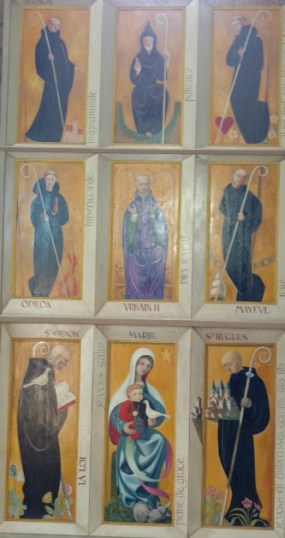


 Pastor 139