 Roger Schütz was born in Switzerland in the days before World War I. He grew up hearing stories about his French grandmother caring for refugees from that war. The war had a profound impact on her. She was horrified that Christians would be slaughtering each other in that conflict. She taught her grandson that reconciliation, especially among Christians, was necessary to avoid another war.
Roger, the son of a Protestant minister, went on to study theology at the universities of Strasbourg and Lausanne. He wrote his dissertation on early monasticism which led him to believe that Protestantism needed an option for an intentional community of prayer and worship.
When war came again to Europe, Roger combined his desire for a monastic life and his compassion to help the victims of the war. In 1940, he left Switzerland and found his way to the village Taize which was near the border between Vichy and free France.
Roger bought a home in Taize and invited his sister to come and help him minister to the refugees in the area, including escaping Jews. Slowly there emerged a pattern of prayer and a way of life at Taize until 1942 when the two were warned to flee the Gestapo who were searching for refugees.
At the end of the war, Roger returned with another who began an intentional community at Taize. This time they were caring for victims of the war including abandoned children and also German prisioners of war.
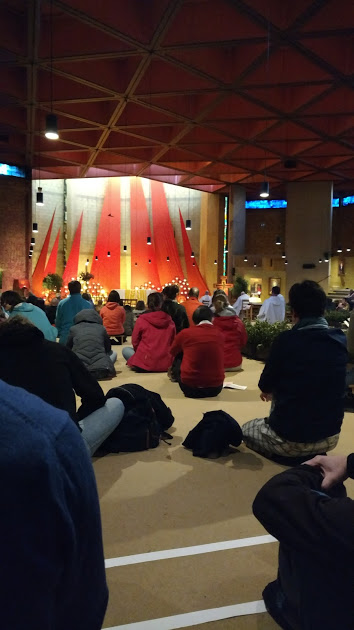 As the community grew, Roger developed a rule of life for their Protestant monastery. Later Roman Catholics came, and the community became intentionally ecumenical. In 1959, young people started coming to the community. Many are searching for meaning and wrestling with the social changes that were occurring around them. Hundreds became thousands each year. The Taize community continues to welcome young people from all over the world.
Later, the community would organize events for youth all over the world called, “Pilgrimages of Trust.” These events emphasize reconciliation, simplicity prayer, and trust. These “pilgrimages” were the inspiration for World Youth Day by the Roman Catholic Church.
At the heart of Taize is the worship. Three times a day, the brothers gather for Scripture, prayer, and song. The liturgy is simple and multi-lingual. It combines many religious traditions including icons, stained glass, and post-modern art. Many find the times of worship quite meaningful. However, it is really the small group time of bible study, reflection, and common life which provide the foundation for the time of worship.
In 2005, Brother Roger was attacked during worship by a woman suffering from mental illness. He died soon after being stabbed multiple times. The contrast of a life dedicated to non-violence and such a violent death is quite shocking. However, his death demonstrates that the work of the community is not done. They remain to show a community in contrast. The community strives to be a witness to the way of Christ.
For More Information…
http://www.telegraph.co.uk/news/obituaries/1496415/Brother-Roger.html

 Pastor 139